AI Coding Interviews: What Engineering Managers Should Check
Most engineering teams don't struggle to find applicants. They struggle to give every applicant a fair technical first round without burning senior engineers' time. AI coding interviews promise to fix that, but quality varies a lot between tools.
Here is what to check before you put one in front of your candidates.
1. Does it ask follow-up questions?
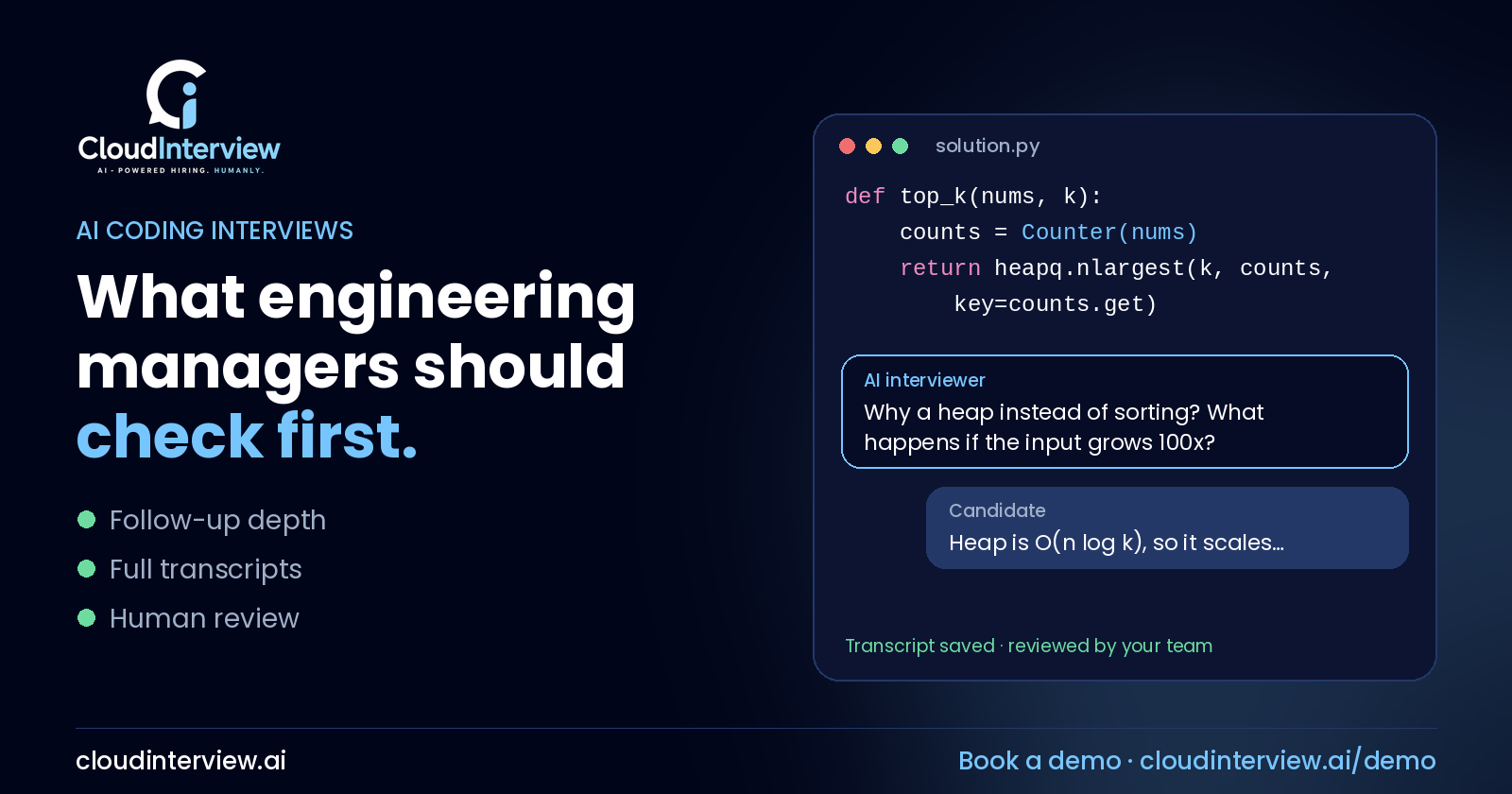
A correct answer tells you little on its own. What matters is why the candidate chose that approach.
Check that the AI asks things like:
- Why this data structure and not another?
- What breaks if the input grows 100x?
- What would you change in production?
A tool that only records answers is a one-way quiz. A conversational AI interview probes reasoning, the way a good senior engineer would.
2. Can you read every answer?
Avoid any tool that gives you a score with no evidence behind it. You need:
- A full transcript of every question and answer
- The reason each candidate was ranked where they are
- The ability to replay or re-read before you decide
If a hiring manager can't see why someone passed, they will re-interview everyone, and you save nothing.
3. Are the questions tied to the role?
A backend role and a frontend role should not get the same interview. Check that you can:
- Set 3–5 must-have skills per role
- Adjust difficulty for junior vs senior
- Update questions without a vendor ticket
4. How does it handle cheating and AI-assisted answers?
Candidates now have AI assistants too. Ask the vendor directly:
- How do follow-up questions expose memorised or pasted answers?
- What integrity signals do you surface, and how are they explained?
- Is a flagged candidate reviewed by a person before any action?
Conversational follow-ups help most here. It's hard to defend reasoning you didn't produce.
5. Who makes the final decision?
The AI should collect evidence. A named engineer or hiring manager should decide who advances. This keeps quality high and helps with rules such as NYC Local Law 144 and the EU AI Act, which expect human oversight and candidate notice.
6. What does the candidate experience look like?
Strong engineers have options. Check:
- Candidates are told up front they're speaking with an AI
- They can take the interview at a time that suits them
- Questions feel relevant, not generic
7. Can you prove it works?
Run it alongside your current process on one or two roles before switching. Track:
- Time to shortlist
- Agreement between the AI shortlist and your engineers' picks
- Onsite pass rate of AI-screened candidates
If agreement is high, expand. If not, fix the role criteria first.
Quick checklist
| Check | What good looks like |
|---|---|
| Follow-ups | Probes "why", not just "what" |
| Evidence | Full transcript + ranking reasons |
| Role fit | Questions set per role and level |
| Integrity | Follow-ups + explained signals + human review |
| Decision | A person approves every advance/reject |
| Proof | Compared with current process before rollout |
Where CloudInterview fits
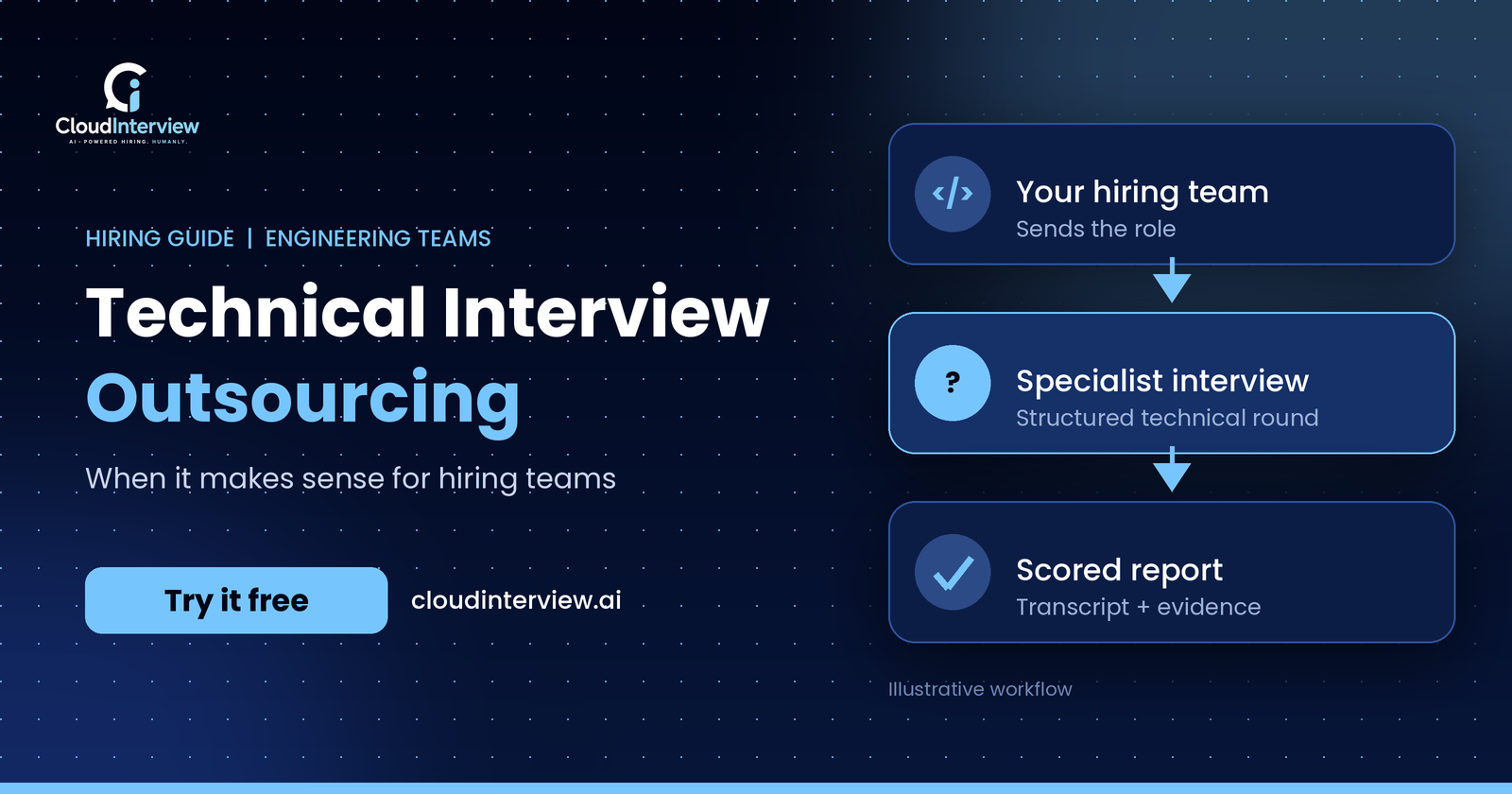
At CloudInterview we built conversational AI interviews around these checks: role-based follow-up questions, full transcripts and human review before any decision. For senior or specialist roles, our expert technical interviewers can take the round for you.
Want to see it on one of your roles? Book a demo or start a free trial.
About the author
- I write about AI interviewing, candidate screening and technical hiring at CloudInterview. We build AI interview software for voice, video and technical screening. https://cloudinterview.ai
Comments
Join the discussionNo comments yet. Be the first to comment.
AI Hiring Playbook for Tech Teams
Practical guides for engineering and hiring managers using AI interviews, phone screening and technical interview outsourcing.